
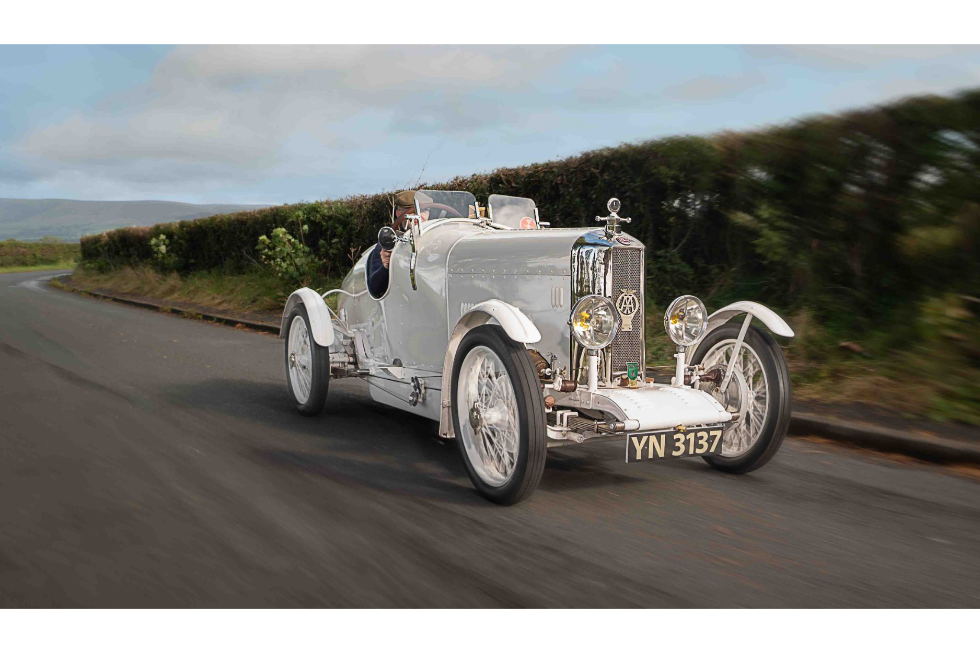


Why do we do it? Why buy and use these cars that are old, often unreliable, and frequently expensive?
Tom was born with petrol for blood, if I’m honest—and the same seems true of our son Daniel, who proudly owns a larger collection of motorcars than most… albeit his are two inches long. Watching Tom, Daniel, and the many, many enthusiasts I’ve met over the years has given me an understanding of what “drives” them—if you’ll pardon the pun!
I’m a neutral observer, really. When I married Tom, I married his cars, but I had no automotive background whatsoever. So it’s been a learning curve—and a genuine fascination. A few years ago, I began to ponder on this, and I would like to share with you what I found.
From our perspective as a dealer, the “Why” is very, VERY important. I cannot overstate that enough. In any form of marketing, your customer’s “why” is the key to understanding their need—and in sales terms, that translates directly into results.
So: What are the Whys in Historic, Motorsport, Classic Performance and Collector Car Ownership?
My observations have led me to conclude that there are three main reasons a person decides to purchase a vehicle like this.
The First Why: Ownership.
Owning the Object of Desire
The title deed. The possession. The artefact. In my hands, with my name on it—now I’m part of the story.
All the cars we buy or sell share one defining factor: a story. Their age, previous owners, what they did decades ago. Accidents, incidents, places they travelled, the people they “rubbed shoulders with” in history. This captivates people. Becoming part of that story is always a driving factor in a car’s purchase, valuation, and desirability.
To own the car that was once owned by… *insert hero here*… is something we really do enjoy. Lives intertwine, and cars offer a way to feel connected—whether to the past or the future.
This is why we encourage every owner to keep their car’s history safe. Go beyond MOTs and invoices. Keep receipts, take photographs at events, save race programmes. I doubt the owner of the Bellevue Special realised that the young man beside him on the grid—Stirling Moss—would one day become such a revered name, adding real value to that car’s provenance.
A car with missing history is missing a piece of itself—and yes, this genuinely affects value.
It’s also very true that family connections are an enormous motivator. Our personal histories matter immensely, and owning something which connects you to the past makes those stories come to life for you, and for those around you.
Another ‘ownership’ motivator can be aesthetics or engineering prowess. For those who are ‘in the know’ owning the ‘very first’ or ‘final iteration’ of something has a particular draw – a well respected or critical moment in time – a pivot point which quietly changed the course of the human/automotive story. A fascination with the rare or unique is a common ‘why’ – being the ‘first’ or having the ‘first’ – or ‘final edition’ extends into every sector.
And the same is true for beauty. We don’t have to think hard to recognise the vast effect of elegance in collector cars; ‘Once a Porsche Man, Always a Porsche Man’ – and the E Type Jaguar is another example. Our son, at three years old – saw one parked in the showroom, sighed deeply and stated “oh thats SUCH a pretty car”.
Some cars just connect with us, and owning them is something that satisfies an inexpressible need.
The Second Why: Access
Opportunities, Purpose and the Joy of Doing
What does this car allow me to do?
Which events can I enter? What clubs can I join? Can I get hands-on with the car—express my skills, my identity, and maintain a sense of purpose?
Event aspirations vary wildly. Many would love to have a car suitable for Monaco Historic, Pebble Beach, or the honour of an invitation to Goodwood. But not everyone gets there—and that’s absolutely fine – and in fact really no big deal!
The truth is – a small budget doesn’t limit the fun. Generations of enthusiasts have proved that there is something for everyone – there is a wide-world of car related things you can do, from quietly fettling some engine parts in your own garage, to the most prestigious racing or concours display events – and everything in between.
And this is truly the attraction for many: access to activity, communication, camaraderie. These things matter to our wellbeing. Old or collector cars offer an impressively broad outlet.
“Access” is about far more than events—it’s access to purpose, challenge, learning, and relationships.
I spotted this clearly one day at Prescott, when a car failed again and every nearby driver and mechanic descended on it—leaning over, pointing, muttering, and I’m sure someone was underneath it too. For all the furrowed brows, they were completely engaged in the process of diagnosing the fault together.
I pointed this out to Tom and said, “You love it really, don’t you—when they break!?”
He looked puzzled… but when I explained he smiled – and didn’t deny it!
I know many in the VSCC running cars worth a great deal – small fortunes in fact—but without massive budgets or family wealth. They do it because they love it. They do the mechanical work themselves, enjoying the engineering challenge just as much as the driving.
These enthusiasts exist in clubs and paddocks worldwide—and they deserve our applause. Keep that in mind next time you wander the pits or watch them compete at Goodwood Revival, that some cars – despite their value – are the product of passion more than pocket.
To own, fix, fettle and drive a car which is tangible, loud, unreliable and tests us, gives many people a sense of purpose and that is, in my experience, a very healthy ‘why’ – whether you are faster than Nuvolari or not!
For us, from a sales perspective, it’s essential to understand what a car gives access to—FIA papers, certain grids, endurance potential—and match that to the right person. Cars and people come in all shapes and sizes, and getting the match right makes all the difference.
The Third Why: Financial
Value, Reality and Keeping It Sensible
This is a strong motivator. Let’s be honest: we all like the idea of something going up in value.
When we started THL in 2010, the historic car market was on the rise, and it lasted for several years. We saw some cars return to us repeatedly, each time worth tens of thousands more. But inevitably, the plateau came, followed by the current ‘buyers market’ we are now in. Economic instability, legislation, the green lobby, red tape, the ebb and flow of fashion, event accessibility—all these factors influence values when cars are treated as assets.
Desirability is mostly driven by the first two factors as listed above (ownership and access) – but affordability and available finance are driven by the economy. When events and usability suffer in economic downturns or similar, desirability shifts – and even when funds return it may not result in a recovery of value.
In short: it’s complex. So we keep it simple.
We never sell a car on the promise that it will appreciate.
To bring balance though, cars can be a way of converting your finances to a tangible form, and it’s certainly worth speaking with an expert if you want to diversify your investments. You can also think about how best to encourage the next generation into motorsport as part of those decisions.
But fundamentally, we do not present cars as a guaranteed route to profit. While it may happen (and we like it when it does!) in fact, we often say the purchase price is simply the down payment for further spending! Ask any racing driver about the cost of their last season and you will quickly understand what we mean!
It comes down to what you want your money to do for you. It’s unlikely that a historic car will ever be worth nothing—but it certainly isn’t guaranteed to rise or even maintain its current sticker price.
We do ask, and always consider in a pre-sales conversation – what is the ‘standing value’ of the car. This is the total worth of the car to the owner, in terms of the total spend – including all the work done to bring it to the current condition. It’s very common that a car’s standing value will exceed its financial valuation. This was sometimes true even back in the heady days of 2008-18! No dealer would be fair to you if they told you anything less than the truth about the current market, so always bear this in mind if they tell you that the outlay you made is unlikely to be recouped on sale.
That’s why it’s important to consider all three reasons together. It’s about valuing your experiences alongside the numbers; the purpose, relationships, achievements and memories that have come with those receipts.
Where This All Ends Up..
In all these considerations, our best advice is to find your own ‘why’.
Finding your personal why helps you choose the car that really will “scratch that itch” and make decisions that you can feel comfortable with in years to come.
And as a dealer, concierge, and collection manager, it’s always our job to try and help you work that out.
Disclaimer:
This blog is for general information and enjoyment only. It is not financial, investment, or legal advice. Values of historic and collector cars can change, and any references to price or provenance are not guarantees. Always verify historical details and seek professional advice before buying, investing in, or working on any car. Drive and maintain vehicles responsibly and in line with all laws and safety guidance.